When the old World meets the New World
How 20 years in Litho Printing Industry led me to tapWEDDINGS
tapWEDDINGS wasn't born from a business plan.It was born from more than 20 years of watching an industry change — and eventually asking myself one very simple question: How can the physical world and the digital world live side by side?
My background is in printing.For more than two decades, I worked in my husband's litho printing business. I started out doing the bookkeeping — teaching myself the difference between an invoice and a statement along the way — but over the years my role grew.I became involved in sales, management, HR, administration, customers, production and pretty much everything in between.And without really knowing it at the time, I was getting an education in print.I learnt about paper.Finishes.Production.Artwork.What people picked up.What they kept.What they threw away.And eventually, what they stopped printing altogether.For years, print was how we communicated.
Theatre programmes.
Flyers.
Brochures.
Invitations.
Maps.
Tickets.
Information sheets.
If you wanted people to know something, you printed it.And then slowly, the world started changing.
Our phones began replacing so many of those pieces of paper.We stopped carrying maps because we had Google Maps.Tickets moved onto our phones.Photos moved into digital galleries.Invitations became digital.Information that once needed a brochure could suddenly be accessed through a link
Then COVID happened.For me, that was when the change accelerated exponentially.
Almost overnight, the whole world went digital because it had to.We were stuck at home.We worked through screens.We shopped through screens.We spoke to our families through screens.We entertained ourselves through screens.Our phones became our offices, our shops, our social lives and our connection to the outside world.
When we eventually all came back to work, I noticed something.We hadn't come back the same.
People weren't buying theatre programmes the way they had before. Businesses didn't necessarily want thousands of flyers. People wanted information sent to their phones. They wanted a link.They wanted a QR code.They wanted something immediate.
It was almost as though those lockdown years had reprogrammed us.And from where I was standing, inside the printing industry, I could actually see it happening. The world wasn't going back.
So I started asking myself:Where does print fit into this new world?Because I still love print.I love beautiful paper.I love beautiful cards.I love something physical that you can touch, hold, give to somebody and keep.But I also understand why digital works.It is immediate.It can hold enormous amounts of information.It can be updated.It can travel with you everywhere.
So why should we have to choose?Why couldn't old-world print and new-world technology work together?That was really the beginning.
Then I discovered NFC.And I remember thinking:Wow. This is really clever.
The funny thing is, NFC isn't new at all.The technology dates back more than 20 years. Sony and Philips began developing Near Field Communication in 2002, it became an international standard shortly afterwards, and the NFC Forum was established in 2004. (Sony)We have actually been using versions of this technology around us for years.Today we tap to pay.We tap to gain access.We tap phones, cards and devices without really giving the technology behind that little action much thought.The NFC Forum itself describes NFC as a short-range wireless technology that allows devices to exchange digital information simply by bringing them close together. (NFC Forum)
And I kept thinking:If this technology can do all of that, why are we using it in such limited ways?When I first started researching NFC cards, so much of what I found was about digital business cards.Tap.Here are my contact details.And I remember thinking…Is that it?
Maybe this is just the way my brain works, but using this incredible little piece of technology only as a business card seemed almost boring to me.
Because ultimately, an NFC card can open a link.And a link can be almost anything.Your website.Your Instagram page.A photo gallery.A wedding website.A Google Drive folder.A registry.Directions.A menu.A video.A thank-you message.A collection of memories.
Suddenly I wasn't looking at a business card anymore.
I was looking at a doorway.
And this is how I started imagining it:Think of a link like the front door of a house.
You walk up to the house.You knock on the door.The door opens.But who says I always have to take you into the lounge?
Today I might take you into the lounge.
Tomorrow I might take you through the house and out to the pool party at the back.
The doorway can stay exactly where it is.Where I take you after you walk through it can change.
And that was the part that fascinated me.
When an NFC product is set up using a managed link or digital destination, the physical printed piece doesn't need to change every time the information behind it changes.The card can remain exactly the same.
The print stays the same.The tap stays the same.
But the experience after the tap can evolve.That, to somebody who has spent more than 20 years in printing, felt huge.
Because traditionally, if information printed on something changed, we printed it again.
Change the telephone number?
Reprint.
Change the dates?
Reprint.
Change the website?
Reprint.
New information?
Reprint.
And suddenly I was looking at a printed product that didn't necessarily have to become obsolete when the information changed.
The physical item could stay.
The digital world behind it could keep moving.
That is where old world meets new world for me.And yes, QR codes can also be created with dynamic destinations.But personally, NFC felt different.
More elegant.More streamlined.More tactile.There was no large square code that needed to become part of my design.No opening a camera and positioning it over something.You simply bring your phone close to the card.Tap.And the door opens.
I loved the simplicity of that.
Then I started looking at weddings.
That was when everything clicked.Because weddings are becoming more digital every year.Wedding websites.Online registries.Digital invitations.Directions.Guest photo galleries.Professional photographs.Videos.Thank-you messages.There are links everywhere.But weddings are also one of the most emotional, physical experiences we have.We still keep things.An invitation.A photograph.A menu.A little favour.Something small from the day that somehow matters because we can hold it in our hands.
There it was.That was the gap I saw.
Why couldn't we have both?Why couldn't a beautiful physical wedding favour also be the key to the digital wedding?
Why couldn't something a guest takes home in their hand continue connecting them to the wedding long after the day itself?Not another app.Not another piece of paper with information that becomes outdated.Not simply another link buried somewhere in a phone.
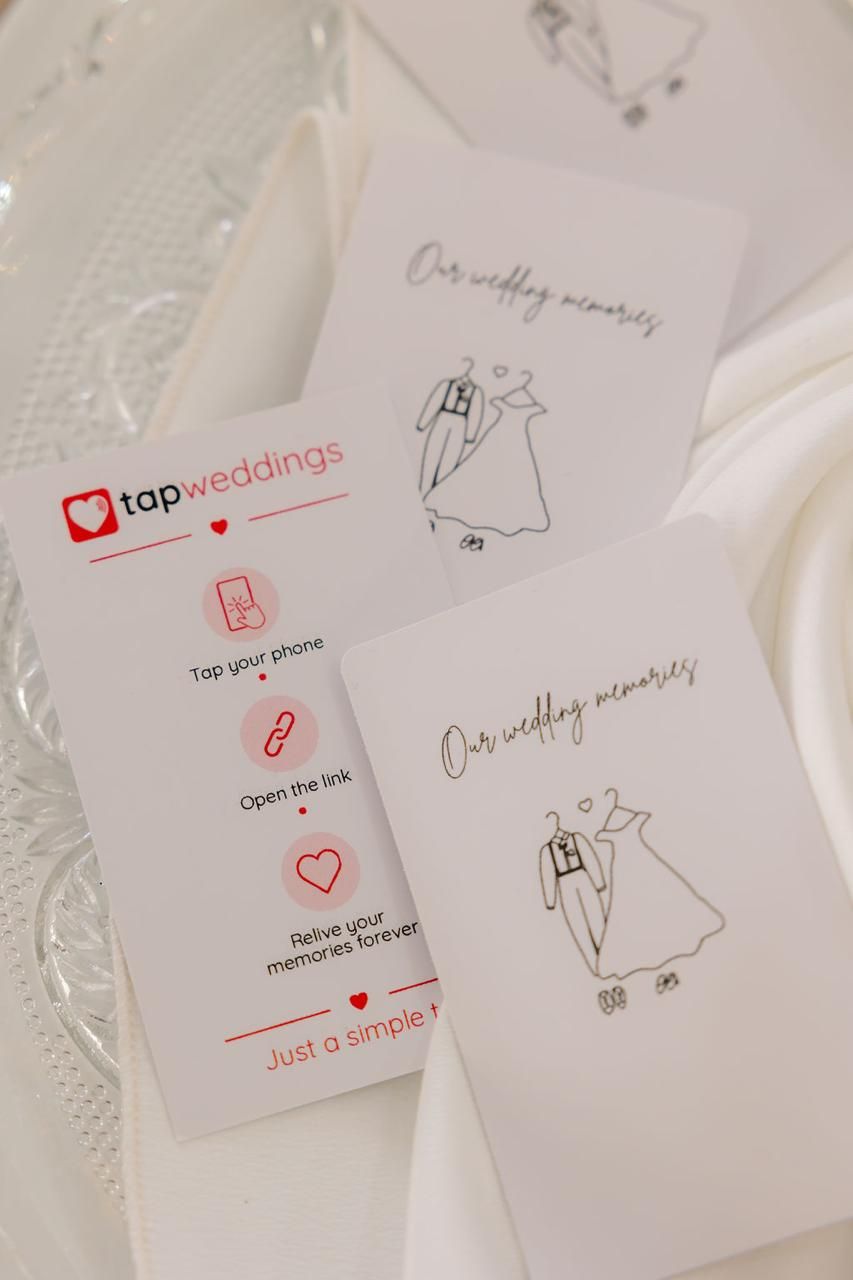
But one beautiful physical card that opens the door to an entire wedding story.Before the wedding.During the wedding.And long after the last dance.Today the tap might take you to the wedding website.Closer to the day, it could take you to the guest photo gallery.After the wedding, the experience could evolve again.Professional photographs.The wedding video.A thank-you message.Anniversary memories.The physical card hasn't changed.
The story behind the tap has.And that is what became tapWEDDINGS.A wedding favour with purpose.
Something tangible, powered by technology.
Something from the old world, connected to the new one.
Perhaps this is the thing I have come to understand after spending so many years in print:Technology doesn't always have to replace what came before it.
Sometimes the most exciting ideas happen when you find a way for the two to work together.
I spent more than 20 years watching the world move from printed material into our phones.
tapWEDDINGS is my way of bringing a little piece of it back out again.Back into our hands.But this time, connected.Living.Changeable.Able to evolve.
Because technology will keep evolving.
The way we communicate will keep evolving.
Weddings will keep evolving.
And I want tapWEDDINGS to evolve with them.
One physical card.
One simple tap.
Endless possibilities behind it.♡ With love, Gabriella